btclib.org
The btclib organization website
The projects
btclib.org
Bitcoin cryptography in Python, written to be read.
These libraries grew out of Ferdinando Ametrano’s Bitcoin and Blockchain Technology course (Università di Milano-Bicocca, Politecnico di Milano, Università Statale di Milano, ESSEC Paris) and are used in production today. They are fully type annotated, cite the BIP, RFC or Bitcoin Core function a behaviour comes from, and are still marked beta because they are still refactored whenever that makes them clearer.
The libraries
- btclib-secp256k1 — Python bindings to libsecp256k1, Bitcoin Core’s optimized C library.
- ecc — elliptic curve arithmetic over any short Weierstrass curve, and the schemes built on it: ECDSA, BIP340 Schnorr, MuSig2, FROST, Diffie-Hellman, commitments and range proofs. For secp256k1 it uses btclib-secp256k1, and tests its own arithmetic against it.
- base58-bech32 — Base58, Base58Check, bech32, bech32m, SS58 and CashAddr codecs, on the standard library alone.
- btclib — bitcoin’s protocol on top of ecc: addresses, scripts, transactions and blocks.
- bip39-slip39 — BIP39, SLIP39 and Electrum mnemonics, from the entropy up to the seed, and nothing of bitcoin above it.
- btclib-wallet — from a seed to a signed, broadcast transaction: BIP32 keys, BIP39 and SLIP39 mnemonics, descriptors, PSBT, coin selection.
- bitcoin-core-rpc — a JSON-RPC client for Bitcoin Core, with nothing but the standard library behind it.
- btclib-benchmarks — timings against comparable libraries, kept apart so btclib never depends on them.
Around them
- btclib-node — a bitcoin full node in Python, built on btclib.
- bitcoin-node-tests — Bitcoin Core’s functional tests rewritten on btclib, to test any node against bitcoind.
- bbt — the course material: spreadsheets, notebooks, scripts and a regtest lab.
- portanode — Bitcoin Core and Electrum on a portable disk, for macOS, Windows and Linux.
- .github — this page, and the standard every repository here follows.
- claude-process —
the process the maintainers follow with Claude Code: the
/btclib-iss,/btclib-prand/btclib-tablecommands and the writer and reviewer agents. - btclib-org.github.io — the site serving this page at btclib.org.
How they depend on each other
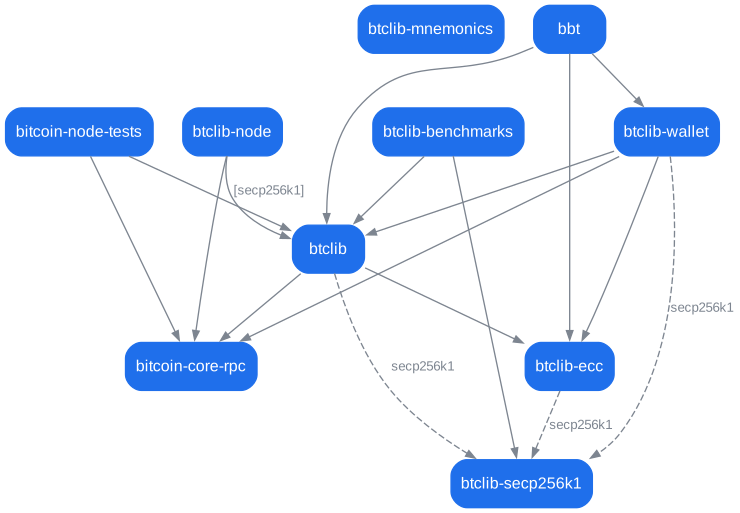
An arrow points at what a package depends on, which is on a row above
it, and a dashed one at what only an extra of the package installs. An
arrow is drawn only where the package does not already install its
target through the arrows that are drawn, so btclib-node has none to
bitcoin-core-rpc, which btclib-wallet brings. btclib-node keeps
its own to btclib all the same, asking it for the secp256k1 extra,
which btclib-wallet installs btclib without. A grey dashed box is a C
library and not a package of the organization: the dotted line to it
says btclib-secp256k1 bundles it, built in rather than installed beside
it.
Tested against other people’s vectors
The suites answer to vectors published by others (BIPs and SLIPs, Bitcoin Core, HWI, Trezor, RFC 6979), each pinned to its upstream commit and re-checked weekly. Coverage is held at 100%.
Contributing
Development is LLM-based: humans are welcome, as long as they are
comfortable with agentic development ;-). A contribution must have been
read and understood by the person who submits it.
CONTRIBUTING.md
has the rules.
Issues and pull requests go to each repository; its README and
CONTRIBUTING.md say how. A change needs a clean lint gate, a passing
suite at full coverage and signed-off commits.
License
MIT.
The btclib organization and its projects are actively supported by DGI and CheckSig.